Generalisation
The ultimate goal of machine learning is to create a predictive model which performs well on unseen examples (it generalises well).
Generalization is a model’s performance on unseen test data, measured by test error (loss on unseen test data).
Test Error
Loss/error on test examples $(x,y)$ sampled from a test distribution $\mathcal{D}$ $$ L(\theta) = \mathbb{E}_{(x,y)\sim\mathcal{D}} [ (y-h_\theta(x))^2] $$ The expectation $\mathbb E$ can be approximated by averaging many samples
In classical statistical learning, both training and test examples are drawn from the same distribution.
Reasons for Large Test Error
There are two main reasons for large test error:
| Underfitting / Bias | Overfitting / Variance |
|---|---|
| Both training and test error are large | Test error is large |
| Model family is unable to capture the true relationship of the data | Model is fitting to noise which does not reflect the true relationship of the data |
Underfitting / Bias
Model family is unable to capture the true relationship of the data
Test error even if the model were fitted to an infinitely large training set
Overfitting / Variance
Model is fitting to noise which does not reflect the true relationship of the data
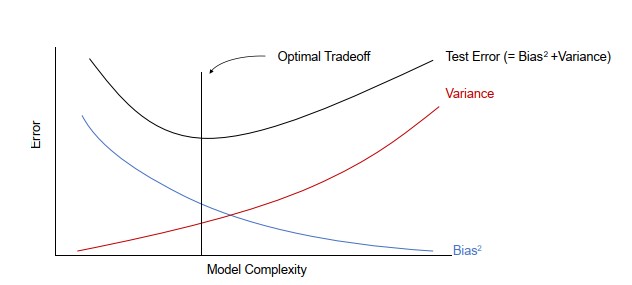
Tradeoff between Bias & Variance
If the model is:
- Too simple : It may have large bias
- Too complex : It may have large variance
Decomposition of Test Error
Test error can be decomposed into three terms $$ \text{Test Error} = \underbrace{\quad \sigma^2 \quad}_\text{noise} + \underbrace{(h^*(x) - h_{avg}(x))^2}_\text{bias} + \underbrace{\text{var}(h_S(x))}_\text{variance} $$ Which results in a convex curve with one global optimum
Double Descent Phenomenon
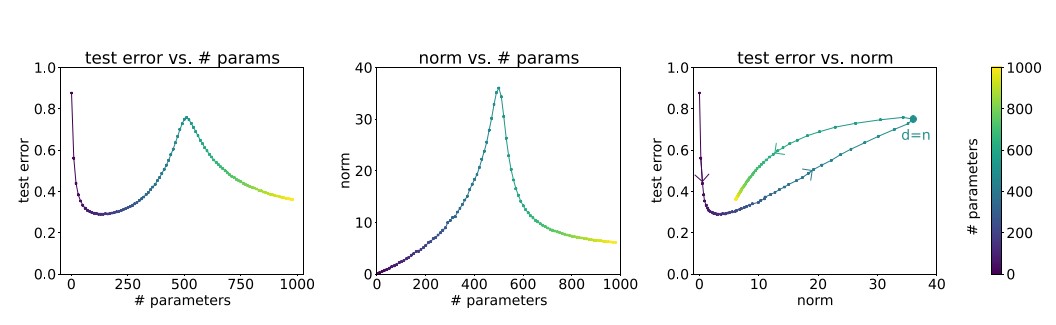
Empirical observation that test error can have a second descent, in the over-parameterized regime (where number of parameters is larger than number of data points)
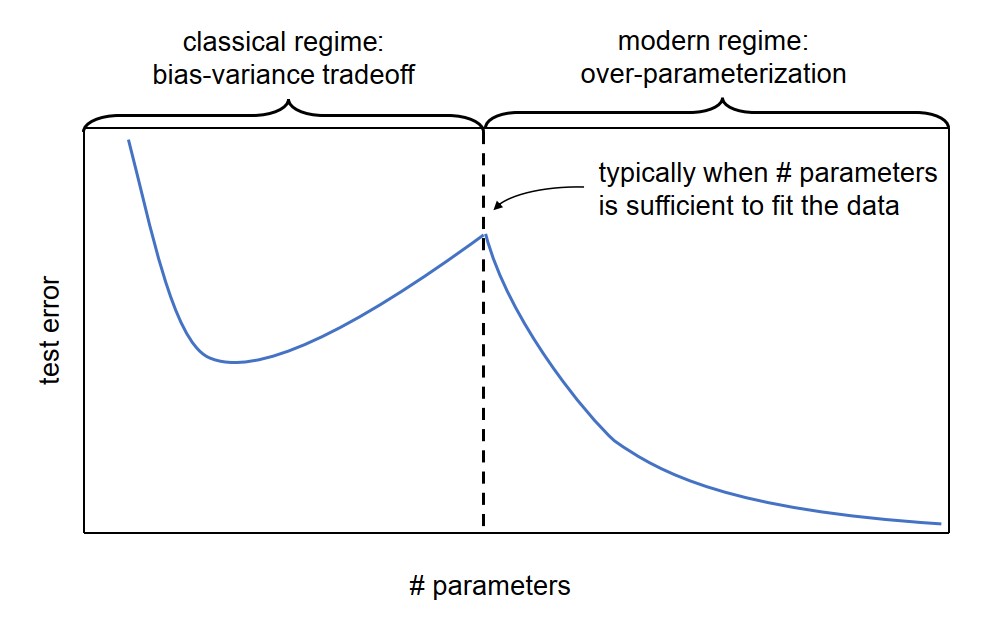
Interestingly in many cases there is no second ascent. Meaning that larger models always lead to better performance
Complexity Measure of Models
It’s not clear that number of parameters is the best way to measure complexity of a model
If the norm is used instead, there is no double descent phenomenon.